In today’s fast-paced digital world, abbreviations and slang dominate online chats. One term that pops up frequently is NSFW.
If you’ve ever scrolled through social media or received a message with this acronym, you might have wondered what it actually means.
People search for it because it signals content that may not be suitable for all audiences, especially in professional or public settings.
Understanding NSFW meaning in text helps you navigate conversations, social media posts, and online communities safely.
This guide will explain the term, its origins, daily usage, and even some tips on how to respond if you encounter it in messages or posts.
What Does NSFW Mean in Text & Chat?
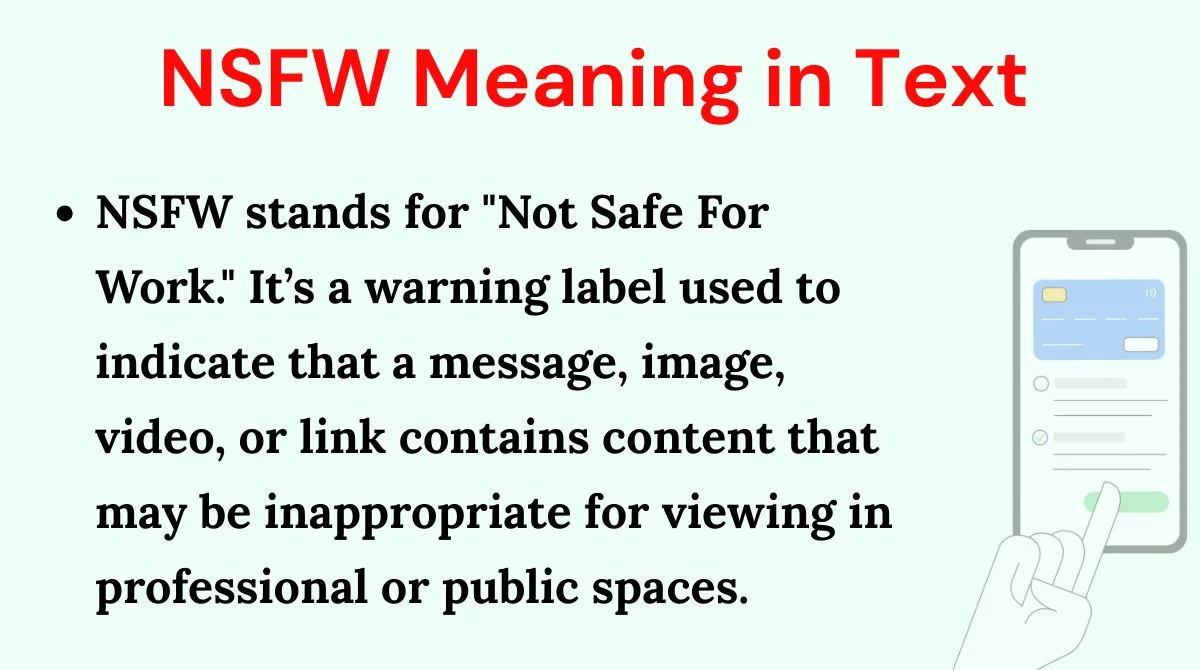
NSFW stands for “Not Safe For Work.” It’s a warning label used to indicate that a message, image, video, or link contains content that may be inappropriate for viewing in professional or public spaces.
This often includes sexually explicit material, graphic images, or other adult content.
- Quick Understanding: NSFW = content you shouldn’t open at work, school, or around others.
- Use in chat: “Hey, here’s a funny meme, but it’s NSFW 😅”
- Purpose: To prevent awkward situations or unintended exposure to explicit material.
Essentially, it’s a courtesy alert so you can decide whether to view the content privately.
Full Form, Stands For & Short Meaning of NSFW
- Full Form: Not Safe For Work
- Short Meaning: Warning for potentially inappropriate content
- Emoji Representation in Chat: 🚫🏢 (symbolic, fun way to show “NSFW”)
Using NSFW in text is a universal shorthand. It’s concise and immediately communicates the nature of content without lengthy explanations.
Origin, History & First Known Use of NSFW
The term NSFW emerged in the early 2000s alongside forums and online communities like Reddit and 4chan.
It became popular as a quick label to flag content that could be explicit or shocking.
- Early Online Use: To prevent users from opening sensitive material at work.
- First Known Use: Around 2002 in tech forums and chat boards.
- Evolution: Now widely used across social media platforms, emails, and messaging apps.
The rise of NSFW content coincided with increasing workplace internet access, making the warning a practical necessity.
How People Use NSFW in Daily Conversations
People use NSFW not just online but in texting, emails, and group chats. Examples:
- Sharing memes with adult humor: “This one’s hilarious but totally NSFW 😂”
- Warning friends before sending a link: “NSFW alert—click at your own risk!”
- Social media posts: Many creators tag NSFW content for transparency.
It’s both a safety warning and a humorous nudge, depending on context.
NSFW Meaning Across WhatsApp, Instagram, TikTok & Snapchat
- WhatsApp: Used in groups or personal chats to warn of explicit memes or videos.
- Instagram: Tagged in posts, reels, or DMs to signal sensitive content.
- TikTok: Often used in captions for edgy or adult-themed videos.
- Snapchat: Private messages may include NSFW to warn friends before opening snaps.
Across platforms, the meaning stays consistent—protecting viewers from content that might be inappropriate for certain settings.
Different Meanings of NSFW in Other Fields
While NSFW usually means “Not Safe For Work,” in niche communities it can slightly vary:
- Gaming: Warning for graphic violence or mature-rated games.
- Art & Comics: Explicit drawings or adult-themed art labeled NSFW.
- Memes & Humor: Indicates content that might be offensive or crude.
The context always revolves around viewer discretion.
Common Confusions, Mistakes & Wrong Interpretations
- Confusion with “SFW”: SFW = Safe For Work (opposite of NSFW).
- Misinterpretation as a virus: Some think NSFW links are unsafe digitally, but it’s just a content warning.
- Overuse: Some tag mild jokes as NSFW unnecessarily.
Tip: Always check the context before reacting.
Similar Terms, Alternatives & Related Slang
- SFW: Safe For Work ✅
- NSFL: Not Safe For Life ⚠️ (more graphic than NSFW)
- 18+: Adult content indicator
- TW: Trigger Warning (related to sensitive content)
These alternatives can help clarify content safety online.
Examples of NSFW in Real Chat Situations
- Group chat: “Guys, NSFW meme incoming 🤣”
- DM: “This video is NSFW, watch privately 👀”
- Forum post: “NSFW! Viewer discretion advised.”
Short, clear, and polite—this is how NSFW is used effectively.
How to Reply When Someone Says NSFW
- Acknowledge the warning: “Got it, I’ll check later 👍”
- Show humor: “NSFW? Challenge accepted 😏”
- Avoid if uncomfortable: “I’ll skip this one, thanks!”
The key is respecting boundaries while staying engaged.
Is NSFW Still Popular? Trends & Online Usage
Yes, NSFW is still widely used. Its relevance continues due to:
- Increasing adult content online
- Need for workplace and school discretion
- Popularity in social media and meme culture
Even with new acronyms emerging, NSFW remains a trusted content warning.
FAQs About NSFW
- What does NSFW mean in TikTok captions?
→ It signals content that may not be suitable for minors or public viewing. - Is NSFW offensive?
→ Not inherently; it’s a warning, not an insult. - Can NSFW apply to images only?
→ No, it can apply to videos, memes, posts, or text messages. - How to politely warn someone about NSFW content?
→ Use: “NSFW alert! Check privately 👀” - Difference between NSFW and NSFL?
→ NSFW = Not Safe For Work; NSFL = Not Safe For Life (more graphic).
Conclusion
Understanding NSFW meaning in text helps you navigate online communication confidently.
It’s a simple, yet essential warning to protect users from adult or inappropriate content, whether in chat, social media, or forums.
Knowing its origins, correct usage, and alternatives like SFW or NSFL ensures you can engage safely and respectfully online.
Next time you see NSFW, you’ll know exactly what it means and how to react—keeping your digital interactions smooth and appropriate.